World Cancer Day: the 9 rules of prevention
World Cancer Day on February 4. On February 4, World Cancer Day is celebrated.
 World Cancer Day on February 4. On February 4 the World Day Against Cancer, World Cancer Day, is celebrated, promoted by the UICC – Union for International Cancer Control – and supported by the World Health Organization (WHO). The Nefrocenter group has always been at the forefront of the fight against cancer through its facilities, including the Rome American Hospital in Rome, its highly specialized health care staff and its diagnostic equipment. The Nefrocenter group is constantly engaged in prevention days so that everyone can have access to care. The Day is an important reminder to reflect on what institutions and individuals can do together to fight cancer. “Close the Care Gap” (closing the gap in care) is also the theme at the heart of the 2024 campaign. The slogan draws attention to the importance of understanding and recognizing inequalities in cancer care around the world.
Cancer numbers worldwide
Cancer, unfortunately, is a disease that is growing worldwide. The International Agency for Research on Cancer (IARC) estimates that there were 20 million new cancer cases in 2022. The IARC’s Global Cancer Observatory estimates that by 2050 there will be over 35 million new cancer cases. The World Health Organization (WHO) confirms that cancer is the second leading cause of death worldwide. The World Cancer Day infographics and WHO data indicate that 10 million people died of cancer in 2020.
In Italy
The report “Cancer Numbers in Italy 2023” estimates that in 2023 there will be 395,000 new cancer cases in Italy (excluding skin cancers other than melanoma), 208,000 new cases in men and 187,000 in women, an increase of more than 18,000 cases in 3 years. There were 390,700 (205,000 in men and 185,700 in women) in 2022 and 376,600 (194,700 in men and 181,900 in women) in 2020.
The most common cancers, in descending order of estimated incidence in the overall population, are:
- breast cancer, for which 5-year net survival from diagnosis is estimated at 88%
- colorectal cancer: it is the second most common cancer in women and the third in men; 5-year survival from diagnosis in Italy is estimated at 65% in men and 66% in women
- lung cancer: it is the second most common cancer in Italian men and the third most common in women; 5-year survival from diagnosis is estimated at 16% in men and 23% in women
- prostate cancer: it is the most common cancer in men; 5-year net survival from diagnosis is estimated at 91%
- bladder cancer: 5-year net survival from diagnosis is estimated at 80% in men and 78% in women.
Cancer and prevention: preventable risk factors, avoidable deaths
Fighting neoplastic diseases requires a multidisciplinary approach and calls for coordinated, synergistic action at multiple levels, from prevention to improving the overall care pathway for the cancer patient.
With this in mind, in line with the European Cancer Plan, both the National Oncology Plan 2020-2027 (Link) and the National Prevention Plan 2020-2025 (PNP) stress the importance of prevention and early diagnosis alongside treatment and improving the patient’s quality of life.
The 2023 Aiom-Airtum Report indicates that about 40% of new cancer cases and 50% of cancer deaths are potentially preventable, as they are caused by avoidable risk factors, estimates in line with WHO data indicating that 30-50% of all cancer cases can be prevented.
The main modifiable risk factors are tobacco use, poor diet, risky and harmful alcohol consumption, lack of physical activity and a sedentary lifestyle.
Nine rules to follow to reduce risk factors
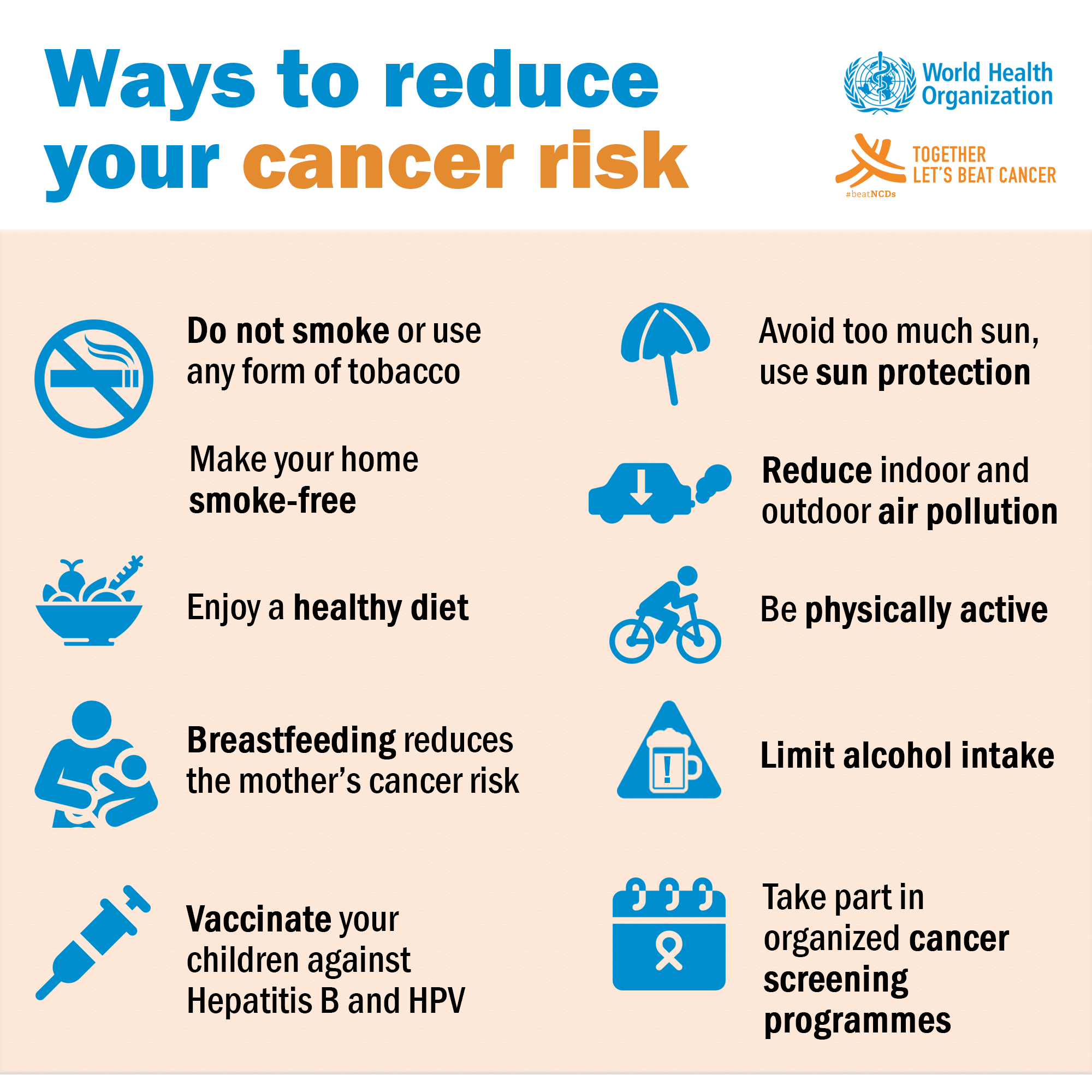
Here are some simple, evidence-based rules that can reduce the risk factors for developing certain forms of cancer.
- Do not smoke. Do not use any form of tobacco. Keep your home smoke-free.
- Follow a healthy, balanced diet
- Remember that breastfeeding reduces the risk of cancer for the mother
- Have your children vaccinated against HPV and hepatitis B
- Avoid excessive sun exposure and apply sunscreen before going out in the sun
- Carefully follow health and safety instructions in the workplace to protect yourself from exposure to carcinogens
- Exercise regularly. Avoid or reduce a sedentary lifestyle
- Reduce or avoid alcohol consumption
- Take part in cancer screening programs
To learn more: WHO infographic