The benefits of postural exercise for the back
The benefits of postural exercise for the back are well known. Postural exercise is one of the most effective and accessible practices
The benefits of postural exercise for the back are now better known than ever. In fact, postural exercise is one of the most effective and accessible practices for improving back health and preventing musculoskeletal disorders. Postural exercise, therefore, is not just a series of exercises, but a true path of education in movement and in awareness of your own body.
What postural exercise is and what its benefits are
Postural exercise is a practice made up of exercises aimed at correcting and improving posture. This form of exercise has no aesthetic or competitive purpose: its aim is to restore balance to the body, improving the quality of everyday movements and reducing the tension that, if neglected, can turn into chronic pain or into actual disorders. The main goals are:
- Align the body correctly in space
- Strengthen the deep muscles (especially the abdominals and the back muscles)
- Improve joint and muscle flexibility
- Relieve or prevent pain caused by bad postural habits
Why posture is so important
Posture is the position our body takes in space, both in static conditions (standing, sitting) and dynamic ones (moving). Good posture ensures the correct alignment of the spine and the balance of the forces acting on muscles, ligaments and joints.
Incorrect posture, maintained over time, can lead to numerous problems, including:
- Back pain, particularly in the neck and lower back
- Muscle contractures and tension that persist
- Joint disorders, especially in the hips, knees and shoulders
- Tension-type headaches, often linked to tension in the neck area
- Reduced mobility and joint stiffness
Many of these problems arise from bad habits that we repeat every day: sitting for many hours, using a cell phone with the neck bent downward, sleeping in unnatural positions or lifting weights incorrectly. To compensate for these imbalances, the body adopts even worse postures, creating a vicious circle that is hard to break without targeted intervention.
The main benefits of postural exercise for the back
Here is a list of the main benefits of postural exercise for the back:
- Reduction of back pain
This is perhaps the most sought-after benefit and also the most evident. Postural exercise acts on the causes of pain and not only on the symptoms: it improves the distribution of load along the spine, releases muscle tension and reduces compression of the intervertebral discs. The results are particularly effective in cases of low back pain, neck pain and sciatica. - Strengthening of the deep muscles
The deep muscles of the trunk – such as the transversus abdominis, the multifidus and the pelvic floor – have the function of supporting the spine and keeping it stable. When these muscles are weak, the back is more prone to stress and pain. Postural exercise helps reactivate these muscles with low-impact exercises, improving the body’s stability. - Improvement of body awareness
Many postural problems stem from the fact that we are not aware of how we move or how we hold ourselves still. Through postural exercise you learn to “feel” your own body: you recognize incorrect attitudes (such as walking with tense shoulders or sitting with a rounded back) and you learn to correct them. This change in perception is essential for maintaining the benefits over time. - Increased mobility and flexibility
Stretching and mobilization exercises help prevent stiffness, especially in sedentary people. A mobile body is less prone to pain and better able to handle complex or sudden movements. The mobility of the spine in its three sections is particularly important: cervical, thoracic and lumbar. - Prevention of future problems
Doing postural exercise does not only mean “treating” but also preventing. People who have already had episodes of back pain should include it in their routine to avoid relapses, but those who do not yet have pain can also benefit enormously, especially if they have static or repetitive jobs. - Recovery after injury or surgery
After spinal surgery or a musculoskeletal trauma, postural exercise can be an essential rehabilitation tool. Of course, it must be performed under the supervision of a physical therapist or a qualified instructor.
Who it is recommended for
Postural exercise is suitable for everyone, regardless of age or fitness level. It is particularly indicated for:
- Adults and older adults with chronic back pain
- Sedentary people, who spend many hours in front of a computer or on their feet
- Children and teenagers with scoliosis, hyperlordosis or hyperkyphosis
- Athletes who want to improve body control
- Women during pregnancy or after childbirth
- People recovering from injuries or surgery
Examples of exercises
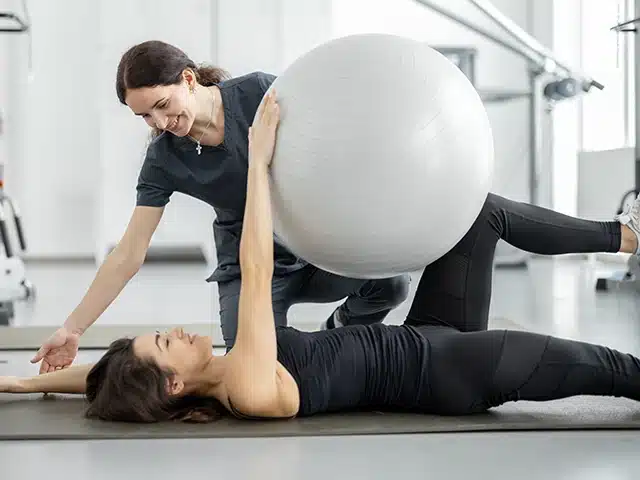
There are some basic exercises, which can also be repeated at home, that are performed in the centers with the specialists of the Nefrocenter group. It is important to perform each exercise slowly, with control and correct breathing. Never force it or work through pain: listening to your body is always the priority.
- Diaphragmatic breathing, essential for relaxing the muscles and improving stability;
- Spinal stretching, such as the “cat-cow” exercise to mobilize the back;
- Core exercises, such as the bridge, the modified plank, and work with small equipment;
- Joint mobilization, useful for keeping the shoulders, hips and knees flexible as well;
- Guided relaxation, with body-awareness exercises to promote psychophysical well-being.
Recommended frequency
To achieve significant and lasting benefits, it is recommended to practice postural exercise at least twice a week. Even short daily sessions of 20-30 minutes can bring improvements, provided they are consistent and accompanied by good postural habits in daily life.