Low creatinine: symptoms, causes and remedies
Low creatinine is an often underestimated condition, yet it can give important clues about the overall state of the body.
A complete guide to understanding when to worry
Low creatinine is an often underestimated condition, but it can provide important information about the overall state of the body, in particular about muscles, metabolism and kidney function.
Unlike high creatinine, which is more often associated with kidney problems, low values can be linked to physiological conditions or to signs that should not be ignored.
What creatinine is and why it matters
Creatinine is a waste product of muscle metabolism, in particular of its breakdown, which is essential for providing energy to the muscles
Once produced:
- it enters the blood
- it is filtered by the kidneys
- it is eliminated in the urine
For this reason it is one of the main indicators of kidney function.
Key concept: It indirectly measures both muscle mass and the efficiency of the kidneys.
Normal creatinine values
Normal values can vary slightly from one laboratory to another, but in general:
| Category | Normal values |
|---|---|
| Men | 0.7 – 1.2 mg/dL |
| Women | 0.5 – 1.0 mg/dL |
Values below these ranges indicate hypocreatininemia.
What it really means
Low creatinine is less common than high creatinine, but it can indicate:
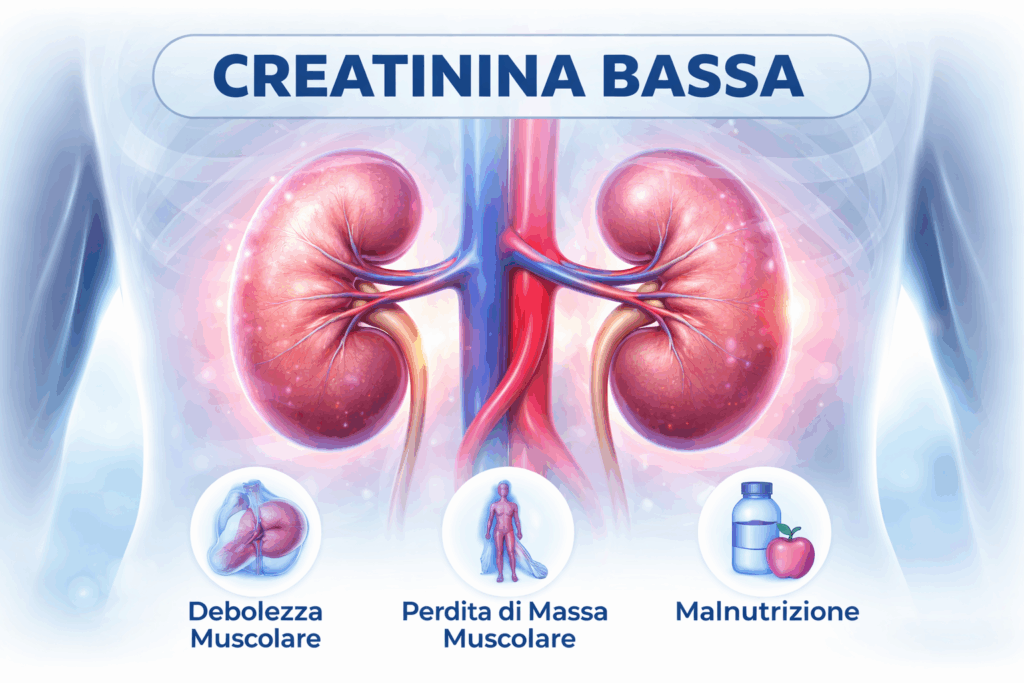
- reduced muscle mass
- malnutrition
- metabolic conditions
- liver changes
In many cases it is not dangerous, but it must always be interpreted in the clinical context.
Key point: The value depends on muscle mass: less muscle = less creatinine.
Causes of low creatinine
1. Reduced muscle mass (most common cause)
- aging
- sedentary lifestyle
- weight loss
- bed rest
It is the most frequent cause
2. Malnutrition
A low-protein diet reduces the production of creatine, causing values to drop.
Typical in:
- drastic diets
- eating disorders
- malabsorption
3. Pregnancy
During pregnancy:
- kidney blood flow increases
- filtration increases
Result: it is lower because of a physiological condition
4. Liver diseases
The liver produces creatine. If it is impaired:
- less creatine means less creatinine
5. Muscle diseases
- muscular dystrophies
- myopathies
- muscle atrophy
6. Renal hyperfiltration
In some cases the kidneys filter faster than normal and the value is lower
Symptoms of low creatinine
Often it does not cause obvious symptoms, but it can be associated with:
- fatigue
- muscle weakness
- cramps
- loss of muscle mass
Note: the symptoms do not depend on the substance itself, but on the cause.
When to worry about low creatinine
It is NOT always dangerous, but you need to look into it further when:
- it is persistently low
- it is associated with weight loss
- there is marked weakness
- chronic diseases are present
Even though it is less serious than high creatinine, it should be evaluated by a doctor
Low creatinine and the kidneys: is there a connection?


It is used to assess kidney function, but: low values almost never indicate kidney failure
More often they indicate:
- reduced muscle
- slowed metabolism
Exception: in rare cases there may be hyperfiltration or metabolic conditions.
Low creatinine in older adults
In older adults it is very common because:
- muscle mass decreases
- metabolism changes
so: it is automatically different from healthy kidneys
It is always necessary to also evaluate:
- eGFR (estimated glomerular filtration rate)
- blood urea nitrogen (BUN)
Low creatinine and sports
In athletes:
- intense training → increased creatinine
- inactivity → decrease
so a low creatinine can indicate:
- insufficient training
- muscle loss
Tests to investigate further
For a complete evaluation:
- creatinine
- eGFR
- blood urea nitrogen (BUN)
- urinalysis
- complete blood count
The combination of these values gives the real picture.
What to eat
Recommended foods
| Category | Foods |
|---|---|
| Protein | eggs, fish, lean meat |
| Vegetables | spinach, broccoli |
| Grains | rice, oats |
| Healthy fats | extra virgin olive oil |
Goal: increase muscle mass
What to avoid
- drastic diets
- protein deficiencies
- prolonged fasting
Remedies
1. Proper nutrition
- adequate protein intake
2. Physical activity
- resistance exercises
- increase in muscle mass
3. Medical checkups
- monitoring of values
4. Treatment of the cause
- nutrition
- specific therapy
Low creatinine and malnutrition
One of the most important signs, if it is associated with weight loss, is possible malnutrition
This is particularly important in:
- older adults
- chronic patients
The relationship with the liver
If the liver is not working well:
- it produces less creatine
- so less creatinine
possible indirect sign of a liver problem
The value in children
In children it is normal to have lower values because:
- lower muscle mass
- different metabolism
In pregnancy
During pregnancy:
- kidney filtration increases
- the value decreases
physiological phenomenon
Creatinine trend chart (concept)
Typical trend:
- high muscle mass results in normal/high
- low muscle mass results in low
useful for clinical interpretation
The difference
| Low | High |
|---|---|
| Reduced muscle mass | Kidney problems |
| Malnutrition | Kidney failure |
| Pregnancy | Dehydration |
| Often physiological | More worrying |
Frequently asked questions (FAQ)
Is low creatinine dangerous?
Not always, but it must be evaluated in the clinical context.
What does low creatinine mean?
It often indicates low muscle mass or malnutrition.
How is it treated?
It depends on the cause: diet, exercise or therapy.
When should I worry?
If it is persistent or associated with symptoms.
Low creatinine is not a disease
It is a parameter that is often overlooked, but it is essential for understanding the overall state of the body.
It is almost never an emergency, but:
- it can indicate nutritional imbalances
- it can reflect muscle loss
- it can point to conditions that need monitoring
Key message: It is not a disease, but a clinical indicator to be interpreted in the context of the patient.
Read also: High or low creatinine: what to do