High-complexity orthopedic surgery at Casa di Cura Santa Rita – NefroCenter Group
At Casa di Cura Santa Rita in Atripalda, elbow function was restored in a 16-year-old using 3D printing and Artificial Intelligence techniques.
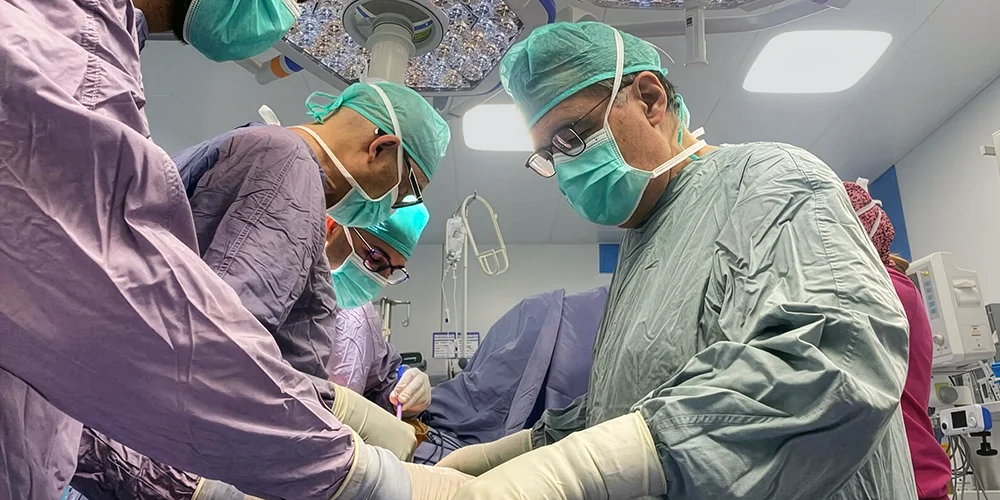
Full elbow function restored to a young 16-year-old patient at Casa di Cura Santa Rita in Atripalda (NefroCenter Group). The surgery, performed with the support of 3D printing and Artificial Intelligence, resolved a complex case of bone malunion while preserving the anatomy of a patient who is still growing.
ATRIPALDA (AV) – In recent days at Casa di Cura Santa Rita in Atripalda, a healthcare facility of the NefroCenter Group and the main hub in Central-Southern Italy for high-complexity orthopedic surgery, a surgical procedure was successfully performed on a 16-year-old. The operation corrected the joint stiffness resulting from a previous elbow fracture.
In August 2022 the young patient had suffered a severe fracture of the left radial head. Despite the initial treatment in childhood, the fracture interfered with the later stage of joint growth. The deformity led to a valgus deviation of the elbow and an alteration of the proximal radioulnar joint, causing a complete and painful block of the rotational movements of the forearm (pronation-supination), with a significant impact on quality of daily life.
The team led by Prof. Raffaele Russo (head of the NefroCenter Group’s High-Complexity Orthopedic Center) and by Dr. Enrico Guerra (director of Shoulder and Elbow Surgery at the Istituto Ortopedico Rizzoli in Bologna), with the collaboration of Dr. Antonio Guastafierro, chose an innovative and conservative approach.
To avoid removing the radial head, which would have caused joint instability and required a prosthetic replacement of the removed fragments, the surgeons used a study based on 3D virtual reality models and three-dimensional printing, integrated with Artificial Intelligence algorithms. This technology made it possible to simulate the surgery in advance, helping them understand how a “measured” osteotomy of the radius (the targeted removal of a small wedge of bone, about one centimeter) could be the least aggressive and most effective solution for the young patient’s elbow.
“This case was managed with the utmost caution and precision – explained Prof. Raffaele Russo. Adolescence calls for choices that protect future development. Since we could not turn to prostheses of doubtful durability in the years to come, we planned a specific technique, supported by digital technologies, to restore function while preserving the natural anatomy.”
At the end of the procedure, the outcome appeared immediately positive: already on the operating table the elbow showed a full range of pronation-supination movement. “The surgery was a success – concludes Prof. Russo. We are extremely satisfied with the technical result. Our goal was to give the young man back the ability to perform the simplest and most natural gestures of life, a goal achieved thanks to meticulous planning and a synergy of international expertise, including the experience of Dr. Guerra gained at the Istituto Ortopedico Rizzoli in Bologna.”
The patient will now begin an early rehabilitation program with the aim of returning to full functional normality in a short time.
“The added value of this case lies in the method of study and planning. Thanks to virtual reality and the creation of physical models derived from the patient’s CT scan, we were able to study and simulate the surgery from every angle on a faithful anatomical model before even entering the operating room – explained Dr. Guerra. This approach means we do not have to ‘invent’ anything in the field, but can act with extreme precision to restore the lost function while respecting the new anatomy that has formed. In a patient this young, the primary goal was to avoid a prosthetic replacement, which at this age should be avoided as much as possible to ensure a full social and working life into old age. “
This surgery confirms the NefroCenter Group’s High-Complexity Orthopedic Center as a reference hub for cutting-edge orthopedic surgery.
Directed by Prof. Raffaele Russo, the Center operates on a multidisciplinary model that integrates high-specialty surgery, preoperative digital planning (3D modeling, three-dimensional printing, virtual simulation) and structured collaboration with the leading national reference centers such as the Istituto Ortopedico Rizzoli.