Kidney transplant and dialysis: differences, quality of life and the waiting list
Kidney transplant and dialysis: differences, quality of life and how to join the waiting list. In the care pathway for kidney disease
Kidney transplant and dialysis: differences, quality of life and how to join the waiting list in Italy. In the treatment of advanced kidney disease there comes a moment when the patient, together with the doctors, faces an important choice. It is not a sudden decision, nor an isolated step, but the result of a clinical journey made of check-ups, evaluations and growing awareness.
When kidney function drops significantly, the body can no longer maintain its internal balance. At this stage, medicine offers two main options: dialysis and kidney transplant. They are two different approaches, both valid, that meet different needs and are chosen based on clinical conditions and individual characteristics.
Understanding what it means to undergo kidney replacement therapy does not concern only the people directly affected. It is a subject that speaks of prevention, quality of life and how modern medicine supports people even in the most complex phases of their health.
Kidney function and what happens when it declines
The role of the kidneys in the body
The kidneys perform a fundamental function in maintaining the body’s internal balance. They filter the blood, remove metabolic waste, regulate fluids and help control blood pressure.
When this function is lost, waste substances begin to build up and the body struggles to keep its systems stable.
Advanced chronic kidney disease
Chronic kidney disease is a progressive condition. In the early stages it can be managed with medication and lifestyle changes. However, when the most advanced stage, known as stage 5, is reached, kidney function becomes insufficient to meet the body’s needs.
At this point we speak of end-stage kidney failure, a phase in which replacement treatment is necessary.
Dialysis and kidney transplant: two different approaches
Dialysis: artificial support for kidney function
Dialysis is a treatment that replaces some of the kidneys’ functions through an artificial process. It filters the blood, removes toxins and maintains fluid balance.
There are two main types:
Hemodialysis, which is performed with a machine that filters the blood several times a week.
Peritoneal dialysis, which uses the peritoneum, a natural membrane in the abdomen, as a filter.
Both types require continuity and organization, but they allow the patient to maintain a stable clinical balance.
Kidney transplant: a surgery that replaces the function
Kidney transplant is a solution that aims to restore kidney function closer to normal. It consists of implanting a healthy kidney from a donor.
Unlike dialysis, a transplant is not a continuous treatment but a surgical operation followed by long-term medication.
Modern medicine considers kidney transplant, when possible, one of the most effective options for improving quality of life.
Dialysis or kidney transplant: differences in daily life
Impact on quality of life
Dialysis requires a precise routine. Sessions, fluid management and diet become an integral part of everyday life.
After the post-operative period, a transplant often allows greater freedom. Kidney function is restored and many of the limitations linked to dialysis are reduced.
Continuity of treatment
Dialysis is a continuous replacement therapy. It cannot be interrupted and requires constant monitoring.
A transplant, on the other hand, begins a new phase of the treatment journey. The patient must follow immunosuppressive therapy to prevent rejection, but can live with greater independence.
Clinical aspects and personalization
The choice between dialysis and transplant is not standardized. It depends on several factors:
age
general health
presence of other conditions
compatibility with a transplant
Contemporary medicine pays great attention to personalizing the treatment path, evaluating each case individually.
The 5 stages of chronic kidney disease
How kidney function levels are classified
Chronic kidney disease does not develop suddenly. It is a gradual process divided into five stages, defined on the basis of the estimated glomerular filtration rate (eGFR), a measure of the kidneys’ ability to filter the blood.
This classification allows doctors to understand how much kidney function is impaired and to set appropriate treatment and monitoring strategies.
Stage 1: normal kidney function with early signs
In the first stage, the kidneys’ filtering function is still within the normal range. However, early signs of damage may be present, such as protein in the urine or structural changes found with imaging tests.
At this stage, prevention plays a key role. Addressing risk factors often makes it possible to avoid progression of the disease.
Stage 2: mildly reduced kidney function
The second stage is characterized by a slight decrease in the glomerular filtration rate. The kidneys continue to work effectively, but begin to show a reduction in their capacity.
There are often no obvious symptoms. Regular monitoring through tests is the main tool for following how the condition evolves.
Stage 3: moderately reduced function
In the third stage the reduction in kidney function becomes more significant. At this point the first clinical signs may start to appear, such as fatigue or changes in blood pressure.
Modern medicine divides this stage into two subgroups for a more precise evaluation. The goal is to slow progression and prevent complications.
Stage 4: advanced impairment
The fourth stage is an advanced phase of the disease. The kidneys’ filtering capacity is significantly reduced and the body may begin to show more obvious symptoms.
At this point, the treatment path also turns toward preparing for replacement therapy, such as dialysis or kidney transplant.
Stage 5: end-stage kidney failure
In the fifth stage, kidney function is severely impaired. The kidneys are no longer able to maintain the body’s internal balance.
This is the phase in which treatments such as dialysis or kidney transplant become necessary. Clinical management is more complex, but also more structured, thanks to advances in medicine.
The value of classification in clinical practice
Dividing the disease into stages is not just descriptive. It helps guide treatment decisions, schedule check-ups and support the patient step by step.
Knowing the stage of the disease means better understanding your own state of health and taking an active part in your care.
Kidney transplant: how it really works
The evaluation process
A kidney transplant is not immediate. The patient must undergo a series of clinical evaluations to confirm eligibility.
These assessments include cardiology, infectious disease and immunology tests. The goal is to ensure that the operation can be undertaken safely.
The surgery
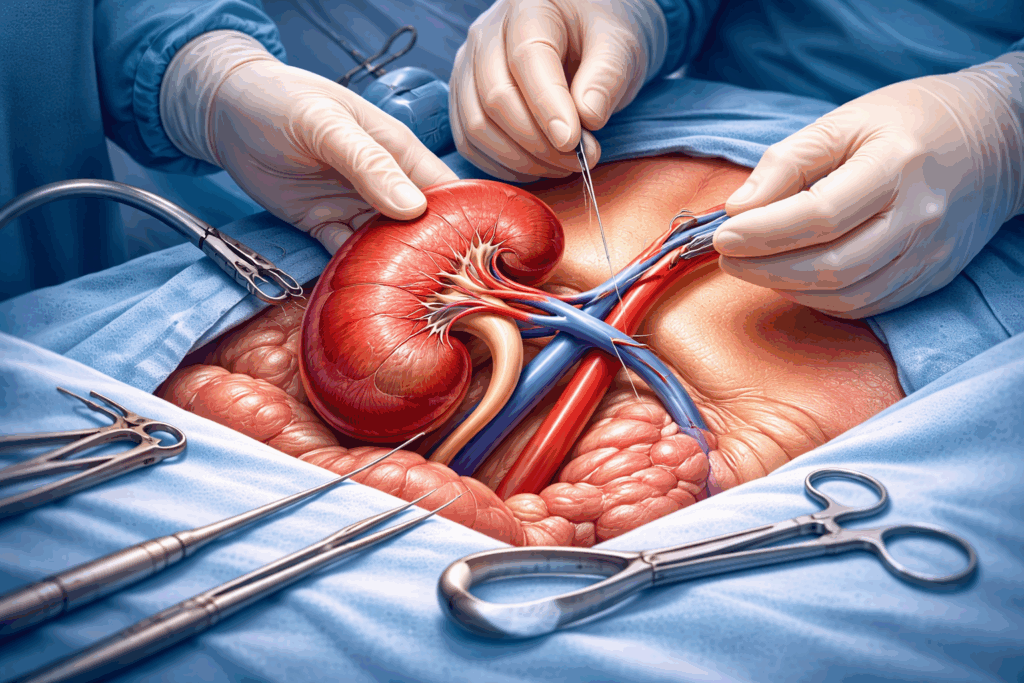
The transplant consists of placing the donated kidney in the patient’s abdomen. In most cases, the diseased kidney is not removed.
The operation is complex but well established in clinical practice, with increasingly advanced techniques and steadily improving results.
The period after the transplant
After the operation, the patient must follow immunosuppressive therapy to prevent rejection of the organ.
This phase requires attention and monitoring, but it also marks the beginning of a new clinical stability.
Kidney transplant waiting list: how it works in Italy
The national transplant system
In Italy, the pathway to a kidney transplant is regulated by the National Transplant System. Waiting lists are managed centrally to ensure fairness and transparency.
Each patient is placed on a list based on clinical and compatibility criteria.
Criteria for joining the kidney transplant waiting list
To be placed on the waiting list, it is necessary to:
have a diagnosis of advanced kidney failure
be clinically eligible
pass the specialist evaluations
Compatibility between donor and recipient is one of the most important factors.
Waiting times
Waiting times can vary depending on several factors, including blood type, immunological characteristics and the availability of organs.
In the meantime, the patient continues their treatment, often through dialysis.
Donation and compatibility
Deceased donor and living donor
A kidney transplant can take place thanks to deceased or living donors. Living donation, when possible, offers shorter waiting times and often better results.
Both types are governed by precise regulations that ensure safety and transparency.
The role of compatibility
Compatibility between donor and recipient is essential for the success of the transplant. Several immunological parameters are evaluated to reduce the risk of rejection.
Over the years, scientific research has improved compatibility techniques, increasing the chances of success.
Modern medicine and the future of transplantation
In recent years, nephrology and transplant surgery have made significant progress. Surgical techniques are increasingly precise, and immunosuppressive drugs are more effective and better tolerated.
At the same time, there is growing attention to the patient’s quality of life. It is not only about prolonging survival, but about ensuring a life that is as active and independent as possible.
Dialysis management has also become more flexible, with home-based options that allow better integration into daily life.
Quality of life
The choice between dialysis and transplant is not only clinical. It concerns daily life, habits, expectations and the way a person wishes to approach their own treatment journey.
Modern medicine does not impose solutions, but builds shared pathways. The patient is supported at every stage, with clear information and ongoing support from the professionals of the NefroCenter Group.
FAQ
Is a kidney transplant always possible?
Not always. It depends on the patient’s clinical condition and on compatibility with the donor.
How long does a transplanted kidney last?
It can vary, but a transplant often allows many years of good kidney function.
Is dialysis a permanent solution?
Dialysis is a replacement therapy that makes it possible to live, but it does not completely replace the function of the kidneys.
How do you get on the kidney transplant waiting list?
Through a clinical evaluation at specialized centers and registration in the national system.
Can you return to a normal life after a transplant?
In many cases yes, with some care regarding therapy and periodic check-ups.