CORI robot
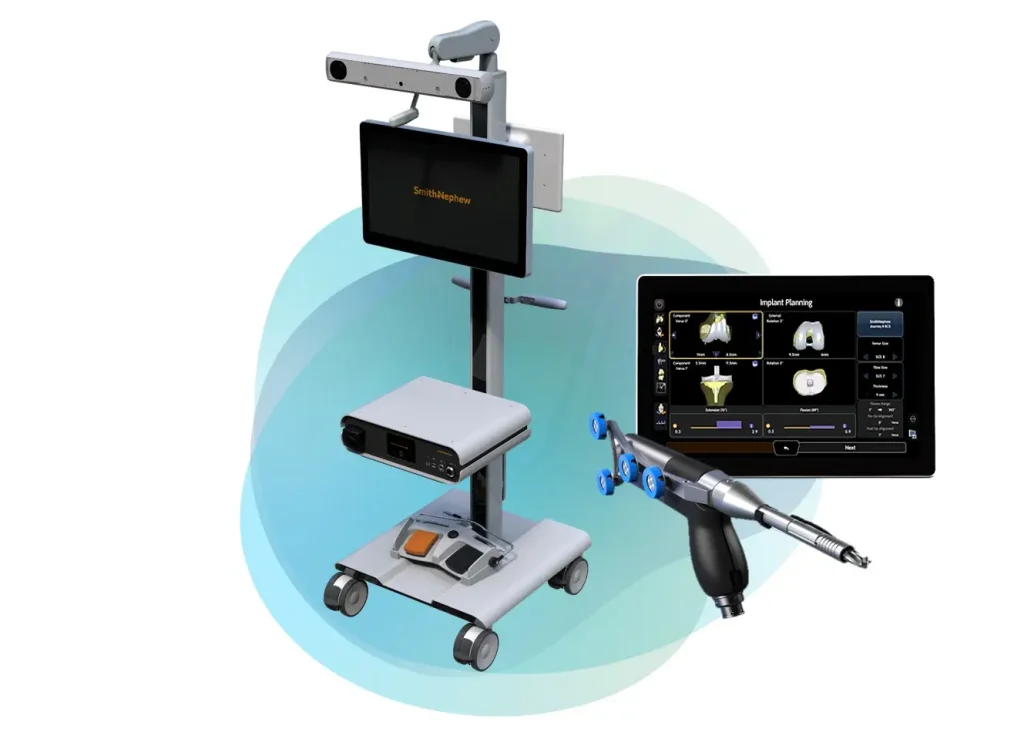
The CORI robot is an advanced computer-assisted surgical system for bone reshaping. It consists of a handheld (haptic) surgical tool fitted with a high-speed burr which, rather than cutting, reshapes the bone. Integrated with the handpiece is surgical planning software that uses a digital pen to perform real-time bone morphing of the anatomical part. This innovative technology eliminates the need for the traditional pre-operative CT scan, providing a three-dimensional image of the patient’s anatomy that is much more true to reality.
The CORI robotic system is therefore a single, intelligent and versatile device that integrates pre-operative planning, real-time surgical navigation and three-dimensional visualization of the knee for the preparation of the bone surfaces. The system precisely tracks the position of the surgical burr moment by moment, ensuring that the planned geometry of the implant is respected and stopping the action in case of deviations.
Robot-assisted orthopedic surgery: the clinical value of the CORI system
In recent years, the use of robot-assisted surgery has revolutionized the approach to knee replacement, improving precision, post-operative recovery, safety and patient satisfaction. The CORI system is one of the most advanced solutions in the field of orthopedic surgery.
Advantages of robotic surgery with CORI/NAVIO
The CORI robot is more accurate because the robotic system allows precise positioning of the implant, reducing bone alignment errors. In fact, 91% of procedures performed with CORI achieve a mechanical alignment within 1° of the pre-operative plan. It also reduces the risk of revision surgery due to malpositioning.
No pre-operative CT scan
Unlike other systems, it does not require a CT scan, reducing time, costs and radiation exposure. It uses real-time intraoperative data to plan and adapt the procedure on the spot.
Faster recovery
Patients who undergo robot-assisted procedures report highly significant data:
- Return to sport after an average of 4.2 months (compared with 10.5 with traditional methods).
- Discharge within 24 hours in selected cases.
- Less pain and greater post-operative mobility.
Competitive surgical times
After the first 10-12 procedures, operating times become similar to those of conventional surgery. The system has a fast learning curve for both experienced surgeons and young orthopedic surgeons.
The safety of CORI
The CORI system has been shown to have no complications directly attributable to the robotic system in the main clinical studies. In addition, surgical risks are in line with or lower than those of traditional surgery.
Clinical evidence
The clinical evidence is important. Revision surgery is reduced to 4% in patients operated on with the robot, compared with 11% with conventional methods. In addition, joint alignment is decidedly improved because there is a reduced average mechanical deviation (e.g. from ±2° to ±0.2°). Added to this is the better restoration of the joint line and the balancing of the compartments during movement. Therefore, CORI has achieved superior clinical results in terms of functional scores (IKSS, KOOS, OKS) and return to daily and sporting activities.
The CORI Surgical System therefore allows orthopedic surgeons to adopt a personalized, dynamic and minimally invasive approach, significantly improving the patient experience and the medium- to long-term outcome.