What the kidneys do: their function and the different diseases caused by malfunction
What do the kidneys do? They filter the blood to remove waste from the body. That is only one answer, and it does not convey how important they are.
What do the kidneys do? They filter the blood to remove waste from the body. That is only one answer, but it does not convey how truly important these two organs are. They are vital organs. Their function is indeed to filter the blood to remove excess waste, excess water and everything the body does not need. They therefore produce urine, through which waste substances are expelled. What the kidneys do is extremely important for our body. In fact, they also regulate our electrolyte balance, blood pressure, the production of red blood cells and bone health through the absorption of calcium.
What the kidneys do: they also regulate electrolyte balance
The electrolyte balance of the kidneys is the result of the electrolytes present inside and outside our cells. Electrolytes are minerals that carry an electrical charge and also have an important biological function. They are:
- calcium
- chloride
- magnesium
- potassium
- sodium
Electrolyte balance is essential for the functioning of the muscles and of the nervous, cardiovascular, respiratory and skeletal systems.
What the kidneys look like and where they are
What the kidneys do is essential, but it is also important to understand how they are built. They are organs located in the abdominal cavity, on either side of the spine. They are bean-shaped. Their color is reddish-brown. Normal-sized kidneys in an adult are 11 to 14 centimeters long. Their height, on the other hand, ranges from 5 to 7 centimeters. Finally, their width is around 3 centimeters. Outside the kidneys there is a layer of fatty tissue that acts as armor against accidental impact.
What the inside of the kidney looks like
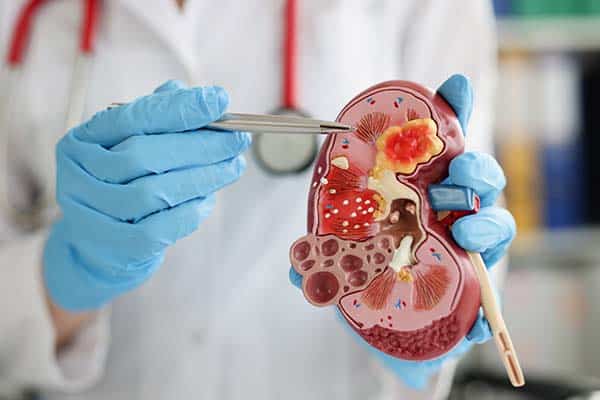
The inner part of the kidney is divided into two main parts, the cortex and the medulla. The renal cortex is the outer part and contains the nephrons, which are the true agents of blood filtration. The inner part is characterized by the renal medulla, which has renal tubules and the loop of Henle, whose function is to reabsorb water and substances useful to the body from the filtered fluid. Each of the two kidneys is connected to a ureter, a sort of small tube that carries urine to the bladder. The bladder is a sort of reservoir where urine is stored until it is expelled through the urethra.
Their vital importance
It is of vital importance for our body to know what the kidneys do. When the two organs do not work properly, the health risk is high. The reason is that homeostasis is not maintained, an internal process of the body that ensures normal physiological parameters. For example, when you have a high fever, it is homeostasis that regulates sweating to prevent body temperature from reaching levels that are lethal for a person. The buildup of excess waste in the blood can be caused by kidney failure.
The different diseases
A variety of diseases can affect the kidneys. They include:
- Glomerulonephritis
- Urinary tract infections
- Kidney failure
- Polycystic kidney disease
- Interstitial nephritis
- Pyelonephritis
To find out whether the kidneys are working properly, it is advisable to have urine and blood tests at NefrocenterLab. If abnormal values emerge, at NefroCenter it is possible to have in-depth nephrology visits with our specialists.
Discover all the NefroCenter centers.