Diabetic retinopathy: what it is, symptoms and treatment
Diabetic retinopathy is one of the complications of diabetes mellitus. It consists of changes in the small blood vessels of the retina
Diabetic retinopathy: symptoms, causes, diagnosis and treatment to protect your eyesight
Diabetic retinopathy is one of the most important complications of diabetes and can develop for a long time without causing obvious symptoms. When vision begins to blur, spots appear in the visual field or reading becomes more difficult, the damage to the retina may already be present. This is why prevention should not start from symptoms, but from regular check-ups.
Having diabetes and seeing perfectly does not necessarily mean that the eyes have not already begun to suffer from the disease. This is precisely one of the most insidious aspects of diabetic retinopathy: in the early stages it can be completely silent.
The person continues to read, drive, use the computer and carry out their normal activities while, in the small blood vessels of the retina, chronic excess glucose may already have set in motion progressively more significant changes.
The retina is an extremely sophisticated and richly vascularized tissue. It lies at the back of the eye and its task is to transform the light entering the eye into nerve signals that the brain uses to build what we see. To work properly it needs a continuous supply of blood, oxygen and nutrients.
Diabetes, especially when it has been present for many years or is not adequately controlled, can damage precisely this delicate network of small vessels.
This is how diabetic retinopathy arises, a microvascular complication of diabetes that is still today an important cause of reduced vision and preventable blindness in adults.
The good news is that a great deal can be done. Controlling diabetes, blood pressure and the other risk factors, undergoing the recommended screening and acting while the disease is still in its treatable stages can radically change the course of retinopathy.
What diabetic retinopathy is and why diabetes damages the eyes
To understand what happens, we need to start from the smallest blood vessels.
Prolonged exposure to high blood glucose levels can progressively alter the structure and function of the microcirculation. The capillaries of the retina can become more fragile, change their permeability, leak fluid or blood, or close, reducing the supply of oxygen to some areas of the retina.
The first changes may include small microaneurysms, hemorrhages and exudates.
When part of the retina receives less oxygen than it needs, the eye may react by producing signals that promote the formation of new blood vessels. It is an attempt at compensation, but these new vessels are abnormal and fragile and can bleed easily.
This is the transition to the more advanced forms of the disease.
Diabetic retinopathy does not, however, appear suddenly from one day to the next. It is generally the result of a process that develops over time and whose risk is closely linked above all to the duration of diabetes and chronic exposure to hyperglycemia.
This is why a person who has lived with diabetes for many years must continue to have their eyes checked even if they have never had vision problems.
Diabetic retinopathy: symptoms can come late
One of the most searched questions online is: what are the symptoms of diabetic retinopathy?
The most important answer is also the one that may come as a surprise: at the beginning there may be no symptoms at all.
It is possible to have early diabetic retinopathy and continue to see normally. Waiting for vision to get worse before having a check-up therefore means giving up the main advantage of screening: detecting the disease before the patient notices it.
As retinopathy progresses, the complaints can become more evident. Vision may appear progressively blurred or fluctuating; reading small print may become more difficult and some people report dark areas, shadows or small floating spots in the visual field.
A sudden increase in floaters or the appearance of vision loss may be linked, among other possible eye causes, to complications that require a rapid specialist assessment.
Not all visual disturbances in a person with diabetes, however, are caused by retinopathy. Diabetes is also associated with other eye diseases and can promote the earlier onset of cataract and glaucoma.
To establish the cause, an eye examination is therefore necessary.
Non-proliferative and proliferative diabetic retinopathy: what is the difference?
The disease is generally divided into different stages.
Non-proliferative diabetic retinopathy is the stage in which changes in the retinal vessels are present but the new abnormal vessels characteristic of the proliferative form have not yet developed.
Even within the non-proliferative form there are different degrees of severity. The disease can therefore evolve over time from early changes to more significant pictures of retinal ischemia.
Proliferative diabetic retinopathy, on the other hand, is an advanced stage. The lack of oxygen stimulates the formation of new blood vessels on the retina or in other structures of the eye.
These vessels are particularly fragile. They can break and cause a hemorrhage in the vitreous body, the gel-like substance that fills the inside of the eye.
In the most advanced cases, fibrous tissue can develop that exerts traction on the retina, increasing the risk of a tractional retinal detachment and of severe vision impairment.
It is easy to understand, then, why detecting the disease before it reaches these stages is one of the fundamental goals of care for people with diabetes.
Diabetic macular edema: when the central part of vision is affected
Diabetic retinopathy can cause another important complication: diabetic macular edema.
The macula is the central region of the retina and allows us to see precisely what we are looking at directly. It is essential for reading, recognizing a face, driving and distinguishing details.
When the vessels damaged by diabetes leak fluid, it can accumulate in the macular region, causing it to thicken.
This is diabetic macular edema.
The person may notice that central vision has become blurred, that reading is more difficult or that images appear less sharp.
Macular edema can appear at different times in the course of retinopathy and is one of the main causes of vision loss related to diabetic eye disease.
This is another reason why it is important not to use the expression “retinopathy” generically as if it covered a single condition: the specialist must establish which part of the retina is affected, how severe the changes are and whether the macula is involved.
Who is most at risk of diabetic retinopathy?
The first major risk factor is time.
The longer a person lives with diabetes, the greater the likelihood that changes in the retina may develop. But the duration of the disease is not the only important element.
Blood glucose control plays a central role. Persistent hyperglycemia promotes microvascular damage, while reaching and maintaining the glycemic targets agreed with the physician helps to reduce the risk of the onset or progression of retinopathy.
Blood pressure also counts. Diabetes and hypertension are a particularly harmful combination for the vascular system, because both can compromise the health of the small vessels over time.
The same applies to abnormalities of blood lipids.
The prevention of retinopathy therefore does not depend solely on the blood glucose value measured at a given moment, but on the overall management of metabolic and cardiovascular health.
Among the factors associated with a higher risk is also diabetic nephropathy.
And it is precisely this link between the eye and the kidney that deserves a closer look.
Diabetic retinopathy and the kidneys: why eye and kidney are closer than we imagine
What do the retina and the kidney have in common?
Much more than it might seem.
Both have an extremely delicate network of small blood vessels. When diabetes damages the microcirculation, the consequences can therefore appear in organs that are apparently very distant from each other.
In the kidney, diabetic damage can contribute to the development of diabetic kidney disease; in the eye it can appear as retinopathy.
This does not mean that those with retinopathy will necessarily develop nephropathy, nor that kidney disease automatically causes damage to the retina. The two conditions do, however, share important mechanisms and risk factors and can coexist in the same patient.
Current evidence in fact indicates nephropathy among the factors associated with a higher risk of diabetic retinopathy.
This relationship makes an integrated view of the person with diabetes particularly important.
We should not think of blood glucose, kidneys, heart and eyes as independent problems to be entrusted to separate specialists who do not communicate with each other. Diabetes is a systemic disease and its complications can affect several organs at the same time.
For an organization such as the NefroCenter Group, historically committed to the prevention and treatment of kidney disease, this concept takes on a special meaning: protecting the kidneys of a person with diabetes means placing their health within a broader pathway that also includes blood pressure, cardiovascular risk and the prevention of the other microvascular complications.
When to have your eyes checked if you have diabetes
This is probably one of the most important pieces of information in the whole article.
According to the American Diabetes Association’s Standards of Care in Diabetes 2026, people with type 2 diabetes should undergo a first comprehensive eye examination with pupil dilation as early as the time of the diabetes diagnosis.
The reason is simple: type 2 diabetes can be present for years before it is diagnosed and, as a result, some people may already have developed retinal changes when they discover they have diabetes.
In type 1 diabetes, in adults, the first comprehensive assessment is generally recommended within five years of the onset of the disease.
Subsequent check-ups are scheduled on the basis of the results.
If one or more annual examinations show no retinopathy and glycemic indicators are within the agreed targets, a screening interval of one to two years may be considered in selected patients. If retinopathy is already present, however, the check-up must be carried out at least once a year and may become much more frequent as the disease progresses or threatens vision.
The message to remember is therefore very simple: people with diabetes should not wait until they see badly to have their retina checked.
How is diabetic retinopathy diagnosed?
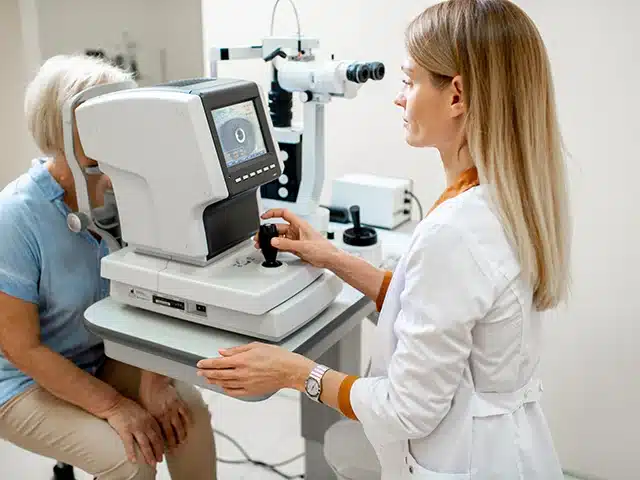
Diagnosis starts with the eye examination and the observation of the retina.
Examination of the fundus of the eye makes it possible to detect many of the changes characteristic of retinopathy, such as microaneurysms, hemorrhages, exudates and signs of ischemia or neovascularization.
Retinal photography makes it possible to acquire photographic images of the retina that can be documented and compared over time.
A very important role is also played by OCT, optical coherence tomography, a non-invasive examination that provides high-resolution images of the layers of the retina and is particularly useful for assessing the macula and identifying or monitoring macular edema.
In selected situations the specialist may use further diagnostic methods to study the retinal circulation and plan treatment.
Technology is also progressively changing screening.
Digital fundus photography, telemedicine and automated analysis systems using artificial intelligence can help to increase the number of people screened, identifying those who need a subsequent specialist assessment.
Screening and a complete eye examination must not be confused, however: a retinal photograph is a very useful tool for identifying patients at risk, but when abnormalities emerge, a specialist assessment is needed.
Diabetic retinopathy: can it be cured?
It is more correct to speak of prevention of progression, control and treatment of complications rather than promising a generic “cure”.
Treatment options have changed profoundly in recent years and today it is possible to act in many situations in which, in the past, the risk of severe vision loss was much more difficult to control.
Treatment is chosen according to the stage of retinopathy, the presence of macular edema, visual acuity and the characteristics of the individual patient.
Not everyone with early retinopathy immediately needs treatment of the eye. In some cases the most important strategy consists of eye monitoring combined with good control of diabetes and the other risk factors.
When the disease reaches certain characteristics, however, specific treatments may be necessary.
Intravitreal anti-VEGF injections: how they have changed treatment
One of the most important innovations in the treatment of the retinal complications of diabetes is represented by anti-VEGF drugs.
VEGF is a protein involved in the formation and permeability of blood vessels. In advanced retinopathy and in diabetic macular edema its activity can contribute to the growth of abnormal vessels and to the leakage of fluid.
Anti-VEGF drugs are administered by intravitreal injections, that is, directly inside the eye according to specialist procedures.
Current recommendations consider anti-VEGF drugs the first-line treatment for most eyes with diabetic macular edema that involves the center of the macula and impairs visual acuity.
They can also be used in certain forms of proliferative diabetic retinopathy.
It is not, however, a “once and for all” treatment. It may require several administrations and regular monitoring, according to the schedule set by the ophthalmologist.
Laser and surgery: do they still have a role?
Yes.
The arrival of intravitreal therapies has not eliminated the role of retinal laser.
Panretinal laser photocoagulation remains an important treatment for reducing the risk of severe vision loss in high-risk proliferative forms and may also be indicated in some severe non-proliferative forms.
For some situations of macular edema, laser and intravitreal corticosteroids may be treatment options when the patient does not respond adequately to anti-VEGF drugs or is not a candidate for first-choice treatment.
In the most advanced pictures, for example in the presence of persistent vitreous hemorrhage or tractional retinal detachment, a vitrectomy may be necessary.
This shows why speaking generically of a “cure for diabetic retinopathy” is reductive. The options are numerous and must be chosen on the basis of the characteristics of the eye and the stage of the disease.
Does controlling blood glucose really protect the retina?
Yes, but it is important to understand clearly what this statement means.
Good metabolic control over time can reduce the risk of developing retinopathy and slow its progression. It does not mean, however, that it is enough to obtain a normal blood glucose for a few days, nor that already advanced retinopathy can be treated solely by lowering blood sugar.
Prevention is a long-term job.
Monitoring glycated hemoglobin (HbA1c) gives an indication of the average trend of blood glucose over the previous months and helps the physician to assess the effectiveness of diabetes management.
Targets are not the same for everyone and must be personalized, considering age, duration of diabetes, treatments, risk of hypoglycemia, kidney function and other conditions.
Alongside blood glucose, blood pressure and the lipid profile must be checked and cardiovascular risk factors addressed as a whole.
Eye, kidney and cardiovascular system often benefit from the same prevention strategies.
Beware of rapid improvements in blood glucose
There is a less well-known but important aspect.
In some people with diabetic retinopathy already present, a very rapid reduction in HbA1c may be associated with an initial worsening of retinopathy.
This does not mean that improving diabetes control is harmful. On the contrary, in the long term good glycemic control is essential.
It does mean, however, that, especially in patients with poorly controlled diabetes and known retinopathy, the intensification of treatment should be accompanied by an appropriate clinical and eye assessment.
It is another example of how important coordinated management is between the diabetologist, the treating physician and the ophthalmologist and, when kidney disease is present, the nephrologist.
Diabetes, pregnancy and retinopathy: why greater attention is needed
Pregnancy deserves a specific mention.
In women who already had type 1 or type 2 diabetes before pregnancy, retinopathy can appear or progress more rapidly. This is why it is important to schedule an eye examination before conception, when possible, and in the early stages of pregnancy, continuing check-ups according to individual risk.
The situation of gestational diabetes, which appears during pregnancy, is different: in the absence of pre-existing diabetes, it does not carry the same risk of developing diabetic retinopathy during pregnancy.
In this area too, therefore, it is important to avoid generalizations and to build surveillance on the clinical history of the individual woman.
Can diabetic retinopathy be prevented?
It is not possible to guarantee that a person with diabetes will never develop retinopathy. It is possible, however, to significantly reduce the risk and above all to lower the likelihood that the disease progresses to the point of severely compromising vision.
Prevention stems from an apparently simple concept: do not wait for symptoms.
It means maintaining the best possible control of diabetes over time according to individual targets, monitoring blood pressure and lipids, not smoking, following the prescribed treatments and regularly undergoing the recommended check-ups.
It also means checking the health of the kidneys.
The presence of albumin in the urine or a reduction in kidney function are not problems separate from the history of diabetes. They can be signs of systemic damage that deserves a broader approach.
A person with diabetes should therefore know, periodically, not only their blood glucose and glycated hemoglobin, but also their blood pressure, kidney function and the state of the retina, according to the guidance of the professionals who follow them.
When to see the ophthalmologist quickly
Scheduled check-ups remain the best strategy because they make it possible to detect retinopathy before symptoms.
There are, however, some changes in vision that should not be put off.
A sudden worsening of vision, the appearance of numerous spots or floaters, a dark area in the visual field, suddenly very blurred images or a loss of vision require a prompt assessment.
These symptoms do not necessarily mean diabetic retinopathy, but they may be the expression of different eye diseases that need to be assessed quickly.
Diabetic retinopathy: protecting the eyes means taking care of the whole body
The retina can be considered an extraordinary window on vascular health.
Through the eye we can directly observe small blood vessels and recognize the consequences that a systemic disease such as diabetes can produce on the microcirculation.
But what happens in the retina must not be considered in isolation.
Diabetes, hypertension, kidney disease and cardiovascular risk are often parts of the same clinical picture. This is why modern prevention cannot be limited to treating a single organ when the problem appears.
The NefroCenter Group has always paid particular attention to the prevention of the complications of kidney disease and of the chronic conditions that can compromise its function. In patients with diabetes, this attention must necessarily be part of a broader view of health.
Checking the kidneys without forgetting the eyes. Checking blood glucose without neglecting blood pressure. And above all, not waiting for a complication to produce symptoms before looking for it.
In the case of diabetic retinopathy this principle takes on an even greater meaning: vision can be perfectly normal while the disease is already beginning.
This is why regular retinal check-ups are not an examination to be done when you start to see badly. They are an integral part of diabetes care.
Frequently asked questions about diabetic retinopathy
What are the first symptoms of diabetic retinopathy?
In the early stages diabetic retinopathy may not cause any symptoms and vision may be normal. As the disease progresses, blurred or fluctuating vision, difficulty with central vision, spots or floaters and, in the most advanced cases, a significant reduction in vision may appear.
Should people with diabetes always have their eyes checked?
Yes, at intervals set on the basis of the type of diabetes and the individual situation. In type 2 diabetes the first comprehensive eye examination is recommended at the time of diagnosis; in adults with type 1 diabetes generally within five years of onset.
How often should the fundus of the eye be examined in diabetes?
The frequency depends on previous results and individual risk. If retinopathy is present, check-ups are generally at least annual and become more frequent if the disease progresses. In some patients without retinopathy and with good glycemic control, intervals of one to two years may be considered.
Does diabetic retinopathy always lead to blindness?
No. Early diagnosis, control of risk factors and the treatments available today allow many patients to significantly reduce the risk of severe vision loss. This is precisely why screening is essential.
What is the difference between diabetic retinopathy and macular edema?
Diabetic retinopathy includes the changes in the retina caused by diabetes. Diabetic macular edema occurs when fluid from the damaged vessels accumulates in the macula, the central area of the retina responsible for detailed vision.
What is the treatment for diabetic retinopathy?
It depends on severity. Monitoring and control of metabolic factors, intravitreal injections of anti-VEGF drugs, laser, intravitreal corticosteroids or vitreoretinal surgery may be indicated in appropriate cases. Treatment must be established by the ophthalmologist.
Are diabetic retinopathy and nephropathy linked?
They are both microvascular complications of diabetes and can coexist. Nephropathy is also associated with a higher risk of diabetic retinopathy. The presence of either condition makes an overall check of the complications of diabetes particularly important.
If I see well, can I still have diabetic retinopathy?
Yes. It is one of the most important aspects of the disease: in the early stages retinopathy can be present without affecting vision. This is why check-ups must be carried out even in the absence of complaints.